
Table of Contents
- Why Federal Law Enforcement Officers Need a Different Approach to Supplements
- Pre-Workout for Law Enforcement: What to Look For and What to Avoid
- Supplements for Shift Workers: Energy, Sleep, and Recovery on Irregular Schedules
- Third-Party Tested Supplements: How to Verify What's Actually in the Bottle
- Supplement Safety for First Responders: Interactions, Medications, and Duty Constraints
- Building a Practical Supplement Stack for Federal Officers
- Frequently Asked Questions
Last Updated: October 18, 2026
Why Federal Law Enforcement Officers Need a Different Approach to Supplements
Walk into any commercial gym and the supplements for federal law enforcement aisle looks the same for everyone. That is the first problem. Supplements for federal law enforcement officers cannot be borrowed wholesale from bodybuilding culture, because the job does not look like a bodybuilding program. It looks like rotating shifts, court overtime, mandatory fitness tests, and long stretches of sitting followed by sudden bursts of physical output.
The confusion starts with the word itself. In federal retirement policy, "supplements" usually refers to the FERS Special Retirement Supplement, a benefit tied to 6(c) coverage and years of service. In nutrition, it means protein powder, creatine, caffeine, and electrolytes. This guide from Executive Protection Fuel covers the second meaning, and we will flag where the two get tangled.

Most officers we talk to are not chasing a personal record. They want to stay alert at hour twelve, pass the annual fitness assessment, and recover fast enough to train again. That is a different goal, and it demands a different stack.
Pre-Workout for Law Enforcement: What to Look For and What to Avoid
Pre-workout for law enforcement should do one thing well: deliver predictable energy without a spike that leaves you flat when the situation escalates. Read the label for stimulant dose per serving, not the marketing name on the tub.
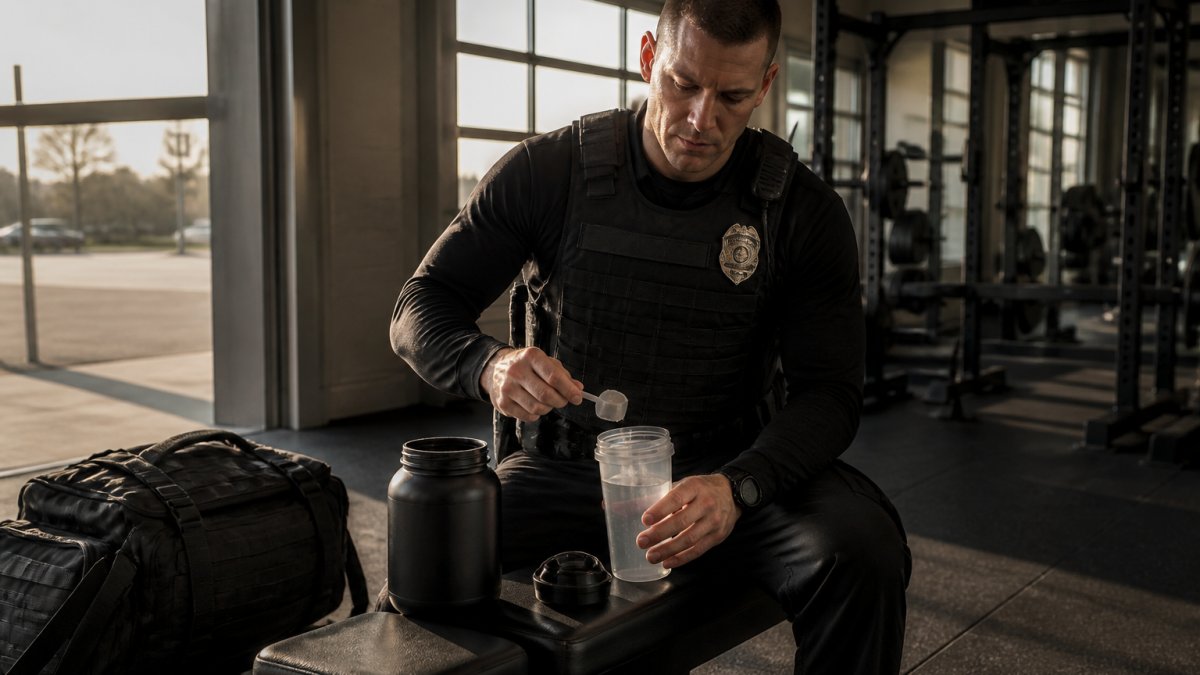
Caffeine is the workhorse ingredient, and the dose matters more than the blend. Many products hide a total stimulant load inside a "proprietary blend," which means you cannot tell how much you are getting. Our rule is simple: if the label does not state milligrams per ingredient, put it back.
What to avoid:
- Blends that stack several stimulants without listing amounts
- Products dosed for a 300-pound lifter when you weigh 180
- Anything you have not tried on a normal training day before trying it on shift
A common mistake is taking a full scoop at 4 p.m. before a night shift and then wondering why sleep is impossible at 8 a.m. Test the dose on a day off first.
Supplements for Shift Workers: Energy, Sleep, and Recovery on Irregular Schedules
Supplements for shift workers solve a problem day-shift athletes never face: the body clock fights the schedule. Rotating shifts, court overtime, and mandatory training compress the window for sleep and recovery, and no capsule fixes a circadian mismatch. What a few basics can do is reduce the friction.
The mechanism worth understanding is the two-process model of sleep regulation. Sleep pressure builds the longer you are awake, while your circadian clock sets the timing of alertness and melatonin release. A night shift puts those two processes in opposition: you are awake when your clock expects sleep and trying to sleep when it expects wakefulness.
For energy, keep caffeine in the first half of your wake window and taper before you plan to sleep. A common pattern is 100 to 200 mg of caffeine early in the shift, then none in the last six hours before a planned sleep period. That range matches roughly one to two cups of coffee, and it is easier to titrate than a pre-workout scoop.
For recovery, protein intake spread across the day supports muscle repair regardless of when your "day" starts. A practical target most practitioners use is 0.7 to 1 gram of protein per pound of body weight per day, split across three to four feedings.
What most guides miss is that sleep is the actual performance supplement. Magnesium and melatonin get a lot of attention, but the evidence is mixed and dosing is individual. Melatonin is a timing signal more than a sedative: small doses taken at the right clock time can help shift workers adjust, but timing matters more than milligrams, and the right schedule is individual.
- Prioritize a dark, quiet sleep space over any capsule. Blackout curtains and earplugs outperform most sleep products.
- Keep a consistent wake time even on days off. Anchoring the wake time is the single strongest lever for shifting the clock.
- Use bright light strategically: seek it at the start of a night shift and avoid it on the commute home before a day sleep.
- Use protein and electrolytes as recovery tools, not stimulants.
- Avoid alcohol as a sleep aid. It shortens sleep onset but fragments the second half of sleep, which is the part that restores you.
A final caution: shift work plus stimulants plus poor sleep is a compounding risk, not a stack. If you need caffeine to get through a shift and something to sleep afterward, that is a signal to talk to a clinician about the schedule itself, not to add another product.
Third-Party Tested Supplements: How to Verify What's Actually in the Bottle
Third-party tested supplements carry a certificate of analysis from an independent lab, not just the manufacturer's own word. That certificate is the only reliable way to know a product matches its label and does not carry contaminants.
Here is how we would check, in order:
EXECUTIVE PROTECTION FUEL - CODE ORANGE - PRE-WORKOUT →
- Look for a named certifying lab or program on the label, not a vague "lab tested" badge.
- Request or find the certificate of analysis and confirm it matches the lot number on your tub.
- Check whether the certificate covers identity, potency, and contaminants like heavy metals and microbes.
- Confirm the product is manufactured in a registered facility.
- Re-check when you buy a new lot, because certificates are batch-specific.
For officers subject to drug screening, this step is not optional. A product that is not tested cannot tell you what it contains, and "natural" on a label is a marketing term, not a guarantee.
Supplement Safety for First Responders: Interactions, Medications, and Duty Constraints
Supplement safety for first responders starts with disclosure. Tell your physician and, where policy requires it, your agency what you take. That is the baseline, but the specifics matter more than the principle.
Stimulants are the interaction class to watch. Caffeine and other stimulants can interact with blood pressure medication, and some ingredients affect heart rate in ways that matter during a high-stress operation. A common pattern is a pre-workout plus an energy drink plus a fat burner adding up to a stimulant load nobody intended.
Other interaction categories worth knowing:
- Blood thinners. Some herbal products, including ginkgo and high-dose fish oil, can affect bleeding risk. If you take an anticoagulant, clear any new supplement with your physician first.
- Blood pressure and heart medications. Stimulants and some botanicals can push heart rate or blood pressure in directions that complicate management.
- Mood and sleep medications. Melatonin and sedating herbs can compound the effects of prescription sleep aids or antidepressants.
- Diabetes medications. Some products marketed for "energy" or "metabolism" carry hidden stimulants or sugars that affect glucose control.
Duty constraints vary by agency and assignment. Some units restrict what you can carry or consume on duty, and fitness-for-duty policies may address supplement use directly. Check your own agency's policy rather than assuming. Occupational health and safety programs are the right office to ask, and the question is routine enough that asking it does not raise a flag.
For officers subject to drug screening, the screening question is separate from the safety question. A product that is not third-party tested cannot tell you what it contains, and "natural" on a label is a marketing term, not a guarantee. Some products marketed as "legal" or "natural" have been found to contain undeclared compounds, which is why the certificate of analysis matters.
The bigger risk is stacking. A pre-workout plus an energy drink plus a fat burner can add up to a stimulant load nobody intended. If you get jittery easily or your heart rate spikes under stress, start with a lower dose or a non-stimulant option and see how you respond.
Building a Practical Supplement Stack for Federal Officers
A practical stack for federal officers is short: a protein source, creatine if your physician clears it, electrolytes for hot or heavy training days, and a pre-workout you have tested on a normal day. Everything else is optional.
| Goal | What to Consider | What to Skip |
|---|---|---|
| Sustained energy | Tested pre-workout, dosed caffeine | Undisclosed stimulant blends |
| Recovery | Protein spread across the day | Products without a certificate |
| Hot or heavy training | Electrolytes | Sugary energy drinks |
| Sleep | Consistent schedule, physician guidance | Unverified sleep aids |
This is where Executive Protection Fuel fits. Our Code Orange pre-workout is built for people who operate under pressure, with energy and focus support in a formula designed for high-demand professionals. Our Lemon Strike formula is amino-acid based, with L-Citrulline, L-Leucine, L-Isoleucine, L-Valine, Taurine, L-Glutamine, Niacin, and Vitamin B6, and it is lab tested. Both are veteran owned and made in the USA. You can see the full lineup at Executive Protection Fuel's product page.

We are not going to tell you a tub replaces sleep or a physician's advice. What we will tell you is that a documented, tested product removes one variable from a job that has plenty.
Frequently Asked Questions
What supplements are commonly used by law enforcement officers?
Officers most often reach for pre-workout formulas for energy and focus before training, protein for recovery, and caffeine or B-vitamin blends to get through long shifts. The practical priority is a product with a transparent label, third-party testing, and no stimulants that spike your heart rate during an already high-stress call. For federal officers, any supplement decision should also account for agency policy and drug-testing rules, so check with your department before adding anything new.
Are pre-workout supplements safe for law enforcement officers?
They can be, if you pick one with a clear ingredient list and testing behind it. The risks come from mega-dose stimulants, proprietary blends that hide amounts, and products that haven't been screened for banned substances. Officers with high blood pressure or heart concerns should talk to a doctor first. Start with a half serving, note how you feel during a high-adrenaline situation, and avoid stacking multiple stimulant products on the same day.
Can supplements affect a law enforcement officer's drug test?
Yes. Some over-the-counter products contain ingredients that can trigger a false positive or violate agency policy. The safest approach is to choose third-party tested supplements, keep the labels, and review the ingredient list against your department's prohibited list before use. If a product doesn't disclose its full formula, skip it. When in doubt, ask your agency's medical or fitness coordinator before you buy.
Are dietary supplements regulated by the FDA?
The FDA regulates dietary supplements as a category of food, not as drugs. That means products don't need pre-market approval for safety or effectiveness before they're sold. Manufacturers are responsible for labeling and for not making false claims, but enforcement happens after problems surface. That's why third-party testing and transparent labels matter more than marketing language when you're choosing a pre-workout or recovery product.
The hard part is not finding a supplement. It is finding one you can defend on a screening form, dose on a twelve-hour shift, and trust when the stakes rise. Executive Protection Fuel builds tested, veteran-owned formulas for exactly that reader: Code Orange for high-alert performance and Lemon Strike for amino-acid-based energy and recovery, both made in the USA. Start with a product you can document, and clock in ready.