
Table of Contents
- Why Supplement Safety Hits Different for Tactical Athletes in 2026
- How to Read a Supplement Label Before You Buy
- Third-Party Tested Supplements for Athletes: What Certification Actually Means
- Creatine for Tactical Athletes: Strength, Power, and the Bloating Myth
- Caffeine Dosage for Athletic Performance: Timing It Around Shifts
- Dietary Supplement Risks and Interactions You Cannot Ignore
- Building a Supplement Stack That Fits the Job
- Conclusion: Buy Less, Verify More
- Frequently Asked Questions
Last Updated: October 12, 2026
Why Supplement Safety Hits Different for Tactical Athletes in 2026
For most people, a bad supplement means wasted money. For tactical athletes, it can mean a failed drug screen, a medical emergency on shift, or a career-ending mistake.
Executive Protection Fuel is a veteran-owned brand built for law enforcement, military personnel, and high-performance professionals. We hear the same concerns from customers every week.

The stakes are real. Military and federal workplaces run their own drug testing programs, and the Department of Defense dietary supplement guidance makes clear that service members are responsible for whatever they put in their bodies.
Below, we break down how to read a label, what third-party testing actually verifies, and which ingredients hold up to evidence.
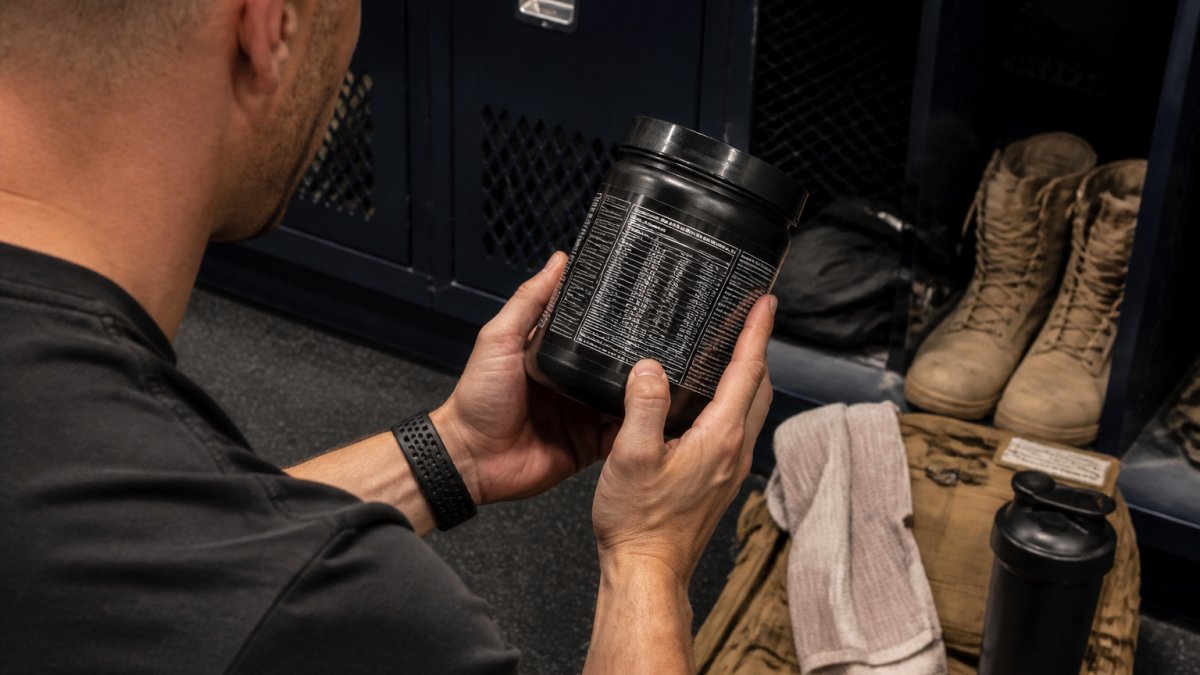
How to Read a Supplement Label Before You Buy
Most label-reading advice stops at "check the serving size." That's the easy part. The hard part is deciding whether the dose in the bottle is actually enough to do anything, and whether the ingredient is even worth taking.
Start with the four items that must be on every label:
- Supplement Facts panel with an amount per serving for every ingredient
- % Daily Value for vitamins and minerals, so you can spot a token dose
- Other ingredients list, where fillers, dyes, and undeclared stimulants hide
If any of those are missing or vague, stop there. A label that won't tell you what's inside is telling you something.
Grade the evidence before you grade the label
A clean label on a useless ingredient is still a waste of money. Before you buy, sort the ingredient into one of three buckets:
Well-supported. Creatine monohydrate, caffeine, protein, and omega-3 fatty acids have decades of human research behind them for performance, recovery, or general health. These are the ingredients worth paying for.
Promising but thin. Beta-alanine, citrulline, and tart cherry have some support for specific outcomes, repeated high-intensity efforts, blood flow, or soreness, but the evidence is narrower and the effective dose matters more. Buy these only when the dose is disclosed and matches what the research used.
Speculative. Most "adaptogen blends," proprietary testosterone boosters, and fat-burner matrices have little to no human performance data at the doses sold. Treat them as marketing, not fuel.
Dose guidance: what a real serving looks like
A label can be honest and still be useless if the dose is a dusting. These are commonly cited effective ranges from the sports nutrition literature, not medical advice, and not a substitute for your own clinician:
- Creatine monohydrate: roughly 3-5 g per day for maintenance; a loading phase of about 20 g per day split into four doses for 5-7 days is optional
- Caffeine: roughly 3-6 mg per kg of body weight, taken 30-60 minutes before effort; start at the low end if you're sensitive
- Protein: enough total daily intake to hit roughly 1.6-2.2 g per kg of body weight, from food first and powder to fill the gap
If a product lists an ingredient but hides the amount inside a blend, you cannot confirm any of this. That's the whole problem with blends.
Proprietary blends and underdosed ingredients
A proprietary blend lists ingredients as a group total, like "Energy Matrix: 3,000 mg." You see the total. You don't see how it's split.
That's a problem. A blend might put 2,900 mg of cheap filler and 100 mg of the ingredient you actually wanted. You have no way to know. When a label won't tell you the dose, treat that as a red flag and move on.
2026 label changes worth knowing
The FDA has been updating its dietary supplement labeling expectations, and the agency continues to remind buyers that supplements are regulated more like food than like drugs, they can reach the shelf without a pre-market safety review.
Third-Party Tested Supplements for Athletes: What Certification Actually Means
Third-party testing means an outside lab, not the manufacturer, checks what's in the product. It's the single most useful safety signal on a label.
Two things get tested: content (does the bottle match the label?) and contamination (are there banned or unsafe substances inside?).
Here's the practical difference between seals:
| What It Checks | Why It Matters |
|---|---|
| Ingredient amounts | Confirms the label is honest |
| Heavy metals | Screens for lead, arsenic, mercury |
| Banned substances | Critical for drug-tested roles |
| Manufacturing standards | Shows the facility meets basic quality rules |
A product that is "lab tested" with no named certifier is a claim, not proof. Ask which lab, and check that the lab actually screens for prohibited substances.
Creatine for Tactical Athletes: Strength, Power, and the Bloating Myth
Creatine is one of the most studied sports nutrition ingredients available. It supports short bursts of power and repeated high-intensity efforts, which fits the stop-start demands of tactical work.
The bloating worry is overblown for most people. Early weight gain on creatine is usually water drawn into muscle, not fat.
A few practical points:
- A common maintenance approach is a small daily dose, taken consistently
- Timing matters less than taking it every day
- Drink enough water, especially in heat
If you're new to it, start low and see how your body responds before a heavy training block.
EXECUTIVE PROTECTION FUEL - CODE ORANGE - PRE-WORKOUT →
Caffeine Dosage for Athletic Performance: Timing It Around Shifts
Caffeine is the workhorse of performance supplements. It supports alertness, focus, and endurance. The catch is timing.
For a day shift, a dose roughly 30 to 60 minutes before training or a demanding period is a common approach.
Caffeine dosage for athletic performance is personal. Body weight, tolerance, and sensitivity all shift the right amount. People who get jittery easily should start at the low end.
Dietary Supplement Risks and Interactions You Cannot Ignore
Dietary supplement risks and interactions are the part most buyers skip. That's a mistake, especially if you take prescription medication.
The FDA regulates supplements differently from drugs. Products can reach the shelf before they're reviewed for safety and effectiveness, as explained in FDA information on dietary supplements.
Watch for these interactions:
- Stimulants and blood pressure meds: can push heart rate and pressure higher
- Blood thinners and certain herbs: can raise bleeding risk
- Iron and some antibiotics: can block absorption of each other
If you take anything daily, run new supplements past your doctor or pharmacist first. This is not optional for people in safety-critical roles.
Building a Supplement Stack That Fits the Job
A stack should match your role, not a magazine ad. A corrections officer on rotating nights has different needs than a soldier in a heavy training cycle, and both have different constraints than an aircrew member who can't risk a sedating or stimulant-heavy product before a flight. This is the part most supplement guides skip entirely.
Start with the fundamentals, not the extras
Before you buy a single capsule, get these right. No supplement outperforms poor sleep, dehydration, or under-eating.
- Hydration and electrolytes. In heat, under load, or in PPE, sodium and fluid losses drive performance and safety more than any powder. Plain water is often not enough for a long detail in the sun.
- Sleep. Caffeine and stimulants mask fatigue; they don't replace sleep. If you're chronically short on sleep, fix that before you optimize anything else.
- Total protein and calories. Hitting daily intake from food first, with powder as a gap-filler, is the highest-return move in the entire stack.
Then layer in the well-supported basics
- Protein to hit daily intake, whey, casein, or a plant blend, whichever you tolerate
- Creatine monohydrate for strength and repeated high-intensity output
- Omega-3 fatty acids for general health support
- Vitamin D, magnesium, and iron only if a blood test shows a gap, iron in particular should never be taken blind
- Caffeine timed around shifts and training, not stacked on top of energy drinks
- Probiotics if digestion is a recurring issue, especially on deployment or travel
Match the stack to the role
This is where tactical athletes diverge from general fitness buyers.
Law enforcement and corrections. Rotating shifts wreck circadian rhythm.
Military service members. You are responsible for what's in your body under your service's drug-testing program.
Aircrew and flight-duty roles. Some ingredients and even some herbal components can affect alertness, hydration, or screening.
Tactical and executive protection. Long, unpredictable hours reward steady, moderate caffeine and amino-acid support over high-stimulant spikes.
Medication and health-condition cautions
Run any new supplement past your doctor or pharmacist if you take anything daily. Common interaction patterns to know:
- Stimulants and blood pressure or cardiac medications can push heart rate and pressure higher
- Blood thinners and certain herbs can raise bleeding risk
- Iron and some antibiotics can block each other's absorption
Verify before you stack
Every product in your stack should carry a named third-party certification that includes banned-substance screening, not just a vague "lab tested" claim. If a brand won't tell you which lab and what it screens for, that's your answer.
At Executive Protection Fuel, our Code Orange pre-workout is built for energy, focus, and endurance under pressure. Our Lemon Strike formula uses amino acids like L-Citrulline, L-Leucine, and L-Glutamine to support training and recovery.

Conclusion: Buy Less, Verify More
The supplement aisle rewards hype, and tactical athletes pay the price. The fix is simple: check the label, demand third-party testing, and match your stack to your actual job demands.
For pre-workout built with that standard in mind, look at what Executive Protection Fuel offers: veteran-owned formulas, designed for energy, focus, and endurance without the crash. Continue shopping and build a stack you can actually trust.
Frequently Asked Questions
How can tactical athletes check whether a supplement is safe?
Start with third-party certification. Look for a certificate of analysis and a certification mark from an independent testing program that screens for prohibited substances, not just purity. Check the ingredient list against the DoD Prohibited Substances list if you are subject to testing. A safe supplement for tactical athletes lists every ingredient with a specific dose, carries a batch number, and comes from a manufacturer that publishes its testing results. If a label hides doses in a proprietary blend, treat that as a reason to walk away.
Can army soldiers take creatine?
Creatine is one of the most studied sports supplements and is not a banned substance under military drug testing programs. Service members can use it, but the source matters. Buy creatine monohydrate from a manufacturer that runs third-party testing, because contaminated products are the real risk, not creatine itself. A standard dose is 3 to 5 grams per day, taken consistently. Check with your command's policy and your medical provider if you have kidney concerns or take prescription medication.
Are third-party-tested supplements safer for military personnel?
They reduce one specific risk: accidental ingestion of banned substances. Independent testing screens for steroids, stimulants, and other compounds that can trigger a positive drug test. It does not guarantee the product is right for you, and it does not eliminate side effects or interactions. For military personnel and law enforcement, certification is a baseline requirement, not a green light. Pair it with a label review and a conversation with your doctor if you take any medication.
Can supplements cause problems with medications or medical conditions?
Yes, and this is where most tactical athletes get caught off guard. Caffeine interacts with stimulant medications and blood pressure drugs. Omega-3 fatty acids can increase bleeding risk when combined with blood thinners. Some herbal ingredients affect how the liver processes prescription drugs. If you take anything daily, including prescriptions for blood pressure, ADHD, or thyroid function, run your supplement list past a pharmacist or physician before you start. Bring the actual labels so they can check doses and ingredients.