
Last Updated: October 28, 2026
Quick Summary
Maintain night shift muscle by spreading 1.6 to 2.2 grams of protein per kilogram of body weight across four or five feedings, training in a fixed window that fits your shift, and protecting sleep with blackout curtains and sunglasses on the commute home. Cut sets by a third after broken sleep instead of skipping the session.
- 12-hour night workers train best right after shift, before sleep.
- The 12-hour shift plan uses three 30-minute sessions per week.
- On days after broken sleep, cut sets by a third and keep the weight the same.
- Pack protein first so hitting your daily target becomes a packing problem.
- Track grip strength, measurements, working weights, and body weight trend to catch muscle loss early.
Table of Contents
- Why Night Shift Muscle Maintenance Comes Down to Three Levers
- Build a Night Shift Workout Schedule Around Your Actual Shift
- The 12-Hour Shift Workout Plan: Three Days, Thirty Minutes
- Night Shift Meal Timing: Protein Targets for Overnight Hours
- Night Shift Sleep and Muscle Recovery: Protecting the Repair Window
- Tracking Progress and Catching Muscle Loss Early
- Supplements for Overnight Workers: What Is Worth It and What Is Not
- Stock Your Shift Bag With Fuel Built for the Job
- Frequently Asked Questions
Why Night Shift Muscle Maintenance Comes Down to Three Levers
Night shift muscle maintenance is the practice of holding on to muscle mass while working overnight schedules that fight your body's natural repair cycles. The cause is rarely laziness. It is biology plus a bad schedule.
The circadian cost of overnight work
Your body runs on a clock. When you sleep during the day and work at night, that clock gets scrambled. According to the National Institute for Occupational Safety and Health on shift work, shift work disrupts sleep and recovery in ways that compound over time.
Protein, training load, and sleep: the levers you can pull
You cannot change the clock. You can change three things:
- Protein intake across the full 24 hours, not just at dinner
- Training load placed where your energy actually exists
- Sleep protection treated as a non-negotiable appointment
Pull those three levers and muscle maintenance becomes realistic. Ignore them and no supplement will save you.
Build a Night Shift Workout Schedule Around Your Actual Shift
Here is how to place training by shift type:
| Shift Pattern | Best Training Window | Why It Works |
|---|---|---|
| 12-hour nights | Right after shift, before sleep | Energy is still up, sleep comes easier |
| 8-hour nights | Before shift, after main sleep | Fresh legs, no rush |
| Rotating shifts | Anchor to sleep, not clock | Consistency beats perfect timing |
For a deeper walkthrough on structuring training around overnight hours, see our guide on how to train while working night shifts.
Pick one window and defend it. Consistency matters more than the perfect hour.
The 12-Hour Shift Workout Plan: Three Days, Thirty Minutes
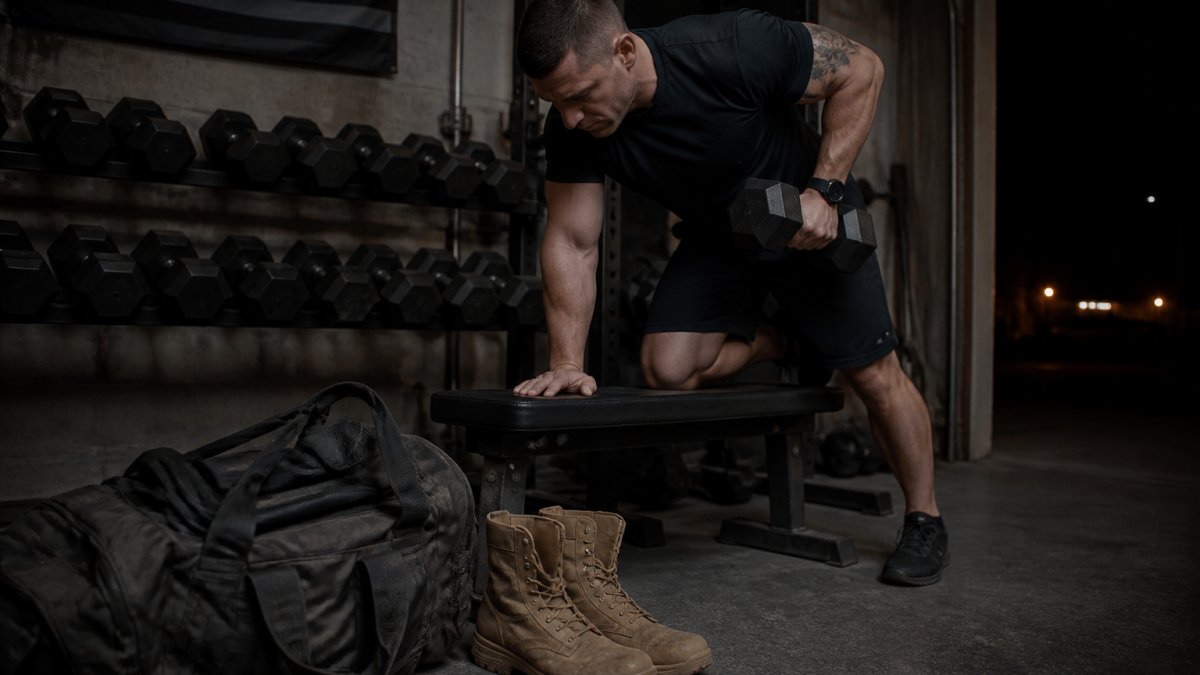
Day 1: Push and pull (30 minutes)
- Dumbbell bench press: 3 sets of 6-8
- Dumbbell rows: 3 sets of 8-10
- Overhead press: 2 sets of 8
- Face pulls: 2 sets of 15
Day 2: Lower body (30 minutes)
- Goblet squats: 3 sets of 10
- Romanian deadlifts: 3 sets of 8
- Split squats: 2 sets of 10 per leg
- Calf raises: 2 sets of 15
Day 3: Full body (30 minutes)
- Trap bar or dumbbell deadlift: 3 sets of 5
- Push-ups: 3 sets to near failure
- Pull-ups or lat pulldowns: 3 sets of 8
- Plank: 3 rounds of 45 seconds
Adjusting volume and intensity when you are sleep-deprived
On days after broken sleep, cut sets by a third and keep the weight the same. You are preserving the signal to keep muscle, not chasing a personal record. A common mistake is skipping the session entirely. Half a workout beats none.
EXECUTIVE PROTECTION FUEL - CODE ORANGE - PRE-WORKOUT →
Night Shift Meal Timing: Protein Targets for Overnight Hours
Night shift meal timing should spread protein evenly across your waking hours instead of loading it all at one meal. A practical target is roughly 1.6 to 2.2 grams of protein per kilogram of body weight per day, split into four or five feedings of roughly 0.4 grams per kilogram each. A food-first approach covers most of it, and the overnight window is where most night workers fall short.
Turn the target into grams you can actually hit
Most people do not think in grams per kilogram, so convert once and write the number on your shift bag. Here is what the range looks like at common body weights:
| Body weight | Daily protein target (1.6-2.2 g/kg) | Per-meal target (4-5 feedings) |
|---|---|---|
| 150 lb (68 kg) | 109-150 g | 25-35 g |
| 180 lb (82 kg) | 131-180 g | 30-40 g |
| 200 lb (91 kg) | 146-200 g | 35-45 g |
| 220 lb (100 kg) | 160-220 g | 35-50 g |
A worked overnight eating schedule
- 5:30 p.m. (pre-shift): 3 eggs, 1 cup of oatmeal, 1 cup of Greek yogurt, about 35 g protein
- 9:00 p.m. (first break): 6 oz chicken breast with rice and vegetables, about 40 g protein
- 1:00 a.m. (mid-shift): protein shake with milk and a banana, about 30 g protein
- 4:00 a.m. (second break): cottage cheese with nuts and berries, about 25 g protein
- 7:30 a.m. (post-workout, before sleep): 6 oz salmon or lean beef with potatoes, about 35 g protein
What to eat between midnight and 6 a.m.
- Greek yogurt (1 cup) with berries, about 20 g protein
- Two hard-boiled eggs and a piece of fruit, about 12 g protein
- A bowl of soup with 4 oz chicken or 1 cup of beans, about 25 g protein
- A protein shake with milk, about 30 g protein
- Cottage cheese (1 cup) with a handful of nuts, about 28 g protein
- Turkey or tuna on a slice of whole-grain bread, about 20 g protein
Calories, carbs, and the overnight eating question
A more useful rule: keep total daily calories roughly matched to your goal, place the largest meals near your training session, and keep overnight meals moderate in size and low in heavy fat and fiber. Carbohydrate is not the enemy on nights, it fuels training and supports sleep onset after your shift. Save the biggest carbohydrate servings for the meal after training and the meal before sleep.
Hydration during the shift
Protein targets mean little if you are chronically underhydrated. Keep a large water bottle within reach all shift and sip steadily rather than chugging at breaks. A simple check: pale yellow urine by mid-shift. Caffeine counts toward fluid but not toward your sleep goals, so time it early in the shift and taper it in the second half.
Night Shift Sleep and Muscle Recovery: Protecting the Repair Window
Build a sleep environment that fights back:
- Blackout curtains or a quality sleep mask
- A cool bedroom, kept dark and quiet
- Sunglasses on the commute home to limit bright light exposure (Combinations of Bright Light, Scheduled Dark, Sunglasses, and Melatonin to Facilitate...)
- A consistent wind-down routine after your shift
- Phone on silent, door closed, household briefed
Tracking Progress and Catching Muscle Loss Early
- Grip strength: same hand dynamometer or a heavy carry for time
- Waist and arm measurements: same spot, same time of day
- Working weights: are your main lifts holding steady?
- Body weight trend: a slow drop with stable lifts is usually fat, not muscle
- **
Supplements for Overnight Workers: What Is Worth It and What Is Not
- **
- **
- **
- **
- **
For a fuller breakdown, read our guide on the best supplements for shift work recovery. If you want a pre-workout, our Code Orange pre-workout and Lemon Strike pre-workout are veteran owned.


Stock Your Shift Bag With Fuel Built for the Job
- A shaker bottle and a serving of pre-workout
- Greek yogurt cups and hard-boiled eggs
- A thermos of soup
- Fruit and a bag of nuts
- A large water bottle
For tactics on staying sharp across long overnights, see our guide on how to maintain energy during long shifts. If you want to browse pre-workout options for your bag, you can shop pre-workout directly.
Frequently Asked Questions
Should you work out before or after a night shift?
Most overnight workers do better training before the shift, when energy is highest and the session will not eat into daytime sleep. If you train after a 12-hour shift, keep it short and lower the load, because fatigue raises injury risk and blunts performance. The practical rule: lift before the shift on your first night back, and use a 20-30 minute session after the shift only when your schedule leaves no other option.
How many days a week should night shift workers lift to keep muscle?
Two to three full-body sessions per week is enough to maintain muscle mass when recovery is limited. On a 12-hour shift workout plan, three 30-minute sessions spaced across the week beat five rushed ones. If sleep drops below six hours for several nights, cut to two sessions and keep the compound lifts, dropping accessory work first. Consistency across months matters more than weekly volume.
What should you eat during a night shift to help maintain muscle?
Aim for 30-40 grams of protein every three to four hours, including one serving between midnight and 6 a.m. Practical options: Greek yogurt with berries, eggs with whole-grain toast, lentil or chicken soup, or a shake if a break is too short for a meal. Pair protein with vegetables and a slow carbohydrate, and keep hydration steady with water rather than energy drinks.
Is four hours of sleep enough for muscle gain?
No. Research on sleep restriction consistently links short sleep to reduced muscle protein synthesis and higher cortisol, which works against night shift muscle maintenance. Seven to nine hours is the target, and broken sleep split into a main block plus a nap is the realistic version for overnight workers. A dark, cool bedroom and sunglasses on the commute home help you get closer to that range.
Night shift work makes muscle maintenance harder, not impossible. The fix is a schedule you can repeat, protein spread across the day, and a sleep window you protect like a duty assignment. Executive Protection Fuel builds lab-tested, veteran-owned pre-workout for people who clock in and never clock out. Our formulas support energy, focus, and endurance for the shifts that demand it. Get started with Executive Protection Fuel and give your training the fuel your schedule requires.
