
Table of Contents
- What Tactical Fitness Training Delivers for the Investment
- Tactical Fitness Program Cost: Breaking Down the Real Numbers
- Tactical Fitness Training Program vs. Conventional Strength and Conditioning
- How to Create a Tactical Fitness Program That Fits Your Schedule
- A Sample Tactical Fitness Workout You Can Run This Week
- Who Benefits Most and Who Should Skip It
- The Verdict: Is Tactical Fitness Training Worth the Investment?
- Frequently Asked Questions
Last Updated: October 14, 2026
What Tactical Fitness Training Delivers for the Investment
Tactical fitness training is a job-specific approach to physical preparation that builds strength, endurance, and durability for the demands of law enforcement, military service, and protective work.
The question is not whether tactical fitness training costs money, but whether it pays you back in readiness, fewer injuries, and better performance when it counts.
The payoff shows up in three places: physical capacity, durability, and stress tolerance.
Strength, Endurance, and the Physical Capacity Your Job Demands
A tactical athlete needs more than raw strength: muscular endurance, cardiovascular endurance, and the ability to move well under load.
That combination is work capacity: how much physical work you can do and how fast you recover. A strong lifter who gasses out on a stair climb is not ready for a foot pursuit, and a marathon runner who cannot drag a partner to safety is not ready either.
So a good tactical fitness training program trains both ends of the spectrum:
- Heavy strength work for power and joint support
- Aerobic capacity for sustained effort across a shift
- Load carriage and rucking for job-specific demands
The goal is a hybrid athlete, not a specialist.
Durability, Injury Prevention, and System Resilience
Durability is the part most programs skip, and the part that protects your career.
Injury resilience comes from smart programming, not luck. Movement quality, progressive overload, and planned recovery reduce breakdown risk, and for people in physically demanding jobs a single serious injury can mean lost pay, lost standing, or a lost assignment.
Tactical Fitness Program Cost: Breaking Down the Real Numbers
Most articles stop at the sticker price, which is the wrong number. The real question is total cost of ownership: coaching, gym access, equipment, testing, and, the line item almost nobody counts, your time.
Here is how the full investment stacks up for a typical working tactical athlete.
| Cost Category | Typical Monthly Range | Notes |
|---|---|---|
| Program or coaching | $0-$500+ | Free templates at the low end; one-on-one coaching at the high end |
| Gym or facility access | $30-$150 | Big-box gym vs. a facility with turf, racks, and sled space |
| Equipment (ruck, sandbag, kettlebells, vest) | $150-$600 one-time | Amortize over 2-3 years; a loaded ruck and a sandbag cover most sessions |
| Fitness testing / assessments | $0-$200 per test | Many departments test in-house for free; commercial assessments cost more |
| Nutrition and supplements | $30-$150 | Optional, but many tactical athletes budget for it |
| Time | 4-8 hours per week | The largest real cost for most people |
Add the recurring lines and a coached program with facility access can run $300-$800 a month before counting a single hour of training time, while a self-guided plan in a basic gym can land under $100.
What You Actually Pay For: Coaching, Programming, and Recovery Tools
Your money buys three things: expertise, structure, and accountability.
- Expertise: someone who corrects your form, spots a movement fault before it becomes an injury, and adjusts the plan when your shift schedule changes.
- Structure: a periodized path instead of random workouts. This is the difference between a plan that builds toward a fitness test and one that just makes you tired.
- Accountability: the reason you show up on the weeks you would rather not. For most people, this is the single highest-value line item.
Recovery tools, mobility work, sleep tracking, deload weeks, protect your gains and are cheap relative to an injury that takes you off the job.
Then there is fuel. Training and nutrition work together, and many tactical athletes use a pre-workout to support energy and focus before demanding sessions. Executive Protection Fuel makes a veteran-owned pre-workout built for exactly this crowd.

The Cost of Doing Nothing
The comparison that matters is not tactical training versus a cheaper program, but versus showing up to a fitness test unprepared or to a foot pursuit with a gas tank that empties in 90 seconds.
A failed fitness test can mean a lost promotion, assignment, or job, and a serious injury can mean weeks of lost pay and months of rebuilding.
Tactical Fitness Training Program vs. Conventional Strength and Conditioning
Conventional strength and conditioning builds general fitness. A tactical fitness training program builds fitness for a specific job.
That difference matters. A powerlifting program optimizes for a single max lift. A bodybuilding split optimizes for muscle size. Neither prepares you to carry a heavy pack for miles and then make a clear decision under fatigue.
Here is how the two compare:
| Factor | Conventional Training | Tactical Fitness Training |
|---|---|---|
| Primary goal | General fitness or aesthetics | Job-specific readiness |
| Strength focus | Max or muscle size | Strength you can use under load |
| Endurance focus | Often optional | Core requirement |
| Injury prevention | Varies widely | Built into the plan |
| Testing | One-rep max, body comp | Fitness assessment and performance testing |
For a civilian chasing general health, conventional training is often enough. For a tactical athlete, the gap is the whole point.
EXECUTIVE PROTECTION FUEL - CODE ORANGE - PRE-WORKOUT →
How to Create a Tactical Fitness Program That Fits Your Schedule
You can build a tactical fitness training program around a demanding job by training fewer days with more intent. Three to four focused sessions a week beat six sloppy ones, especially with unpredictable shifts.
Start with what you can actually sustain. A corrections officer on rotating shifts has a different recovery window than a soldier in a fixed training cycle.
Assess, Periodize, and Progress: A Simple Framework
Use this three-step loop to keep training on track:
- Assess: Test baseline strength, endurance, and movement quality every 8-12 weeks.
- Periodize: Break the year into blocks with a clear focus, such as strength, then conditioning, then peak readiness.
- Progress: Add load, volume, or intensity gradually, and back off when recovery slips.
For more on how physical activity supports performance and health, see CDC physical activity guidance. It is a plain-language starting point for building a base.
A Sample Tactical Fitness Workout You Can Run This Week
Here is a simple circuit you can run this week with minimal equipment, blending strength, conditioning, and load carriage in one session.
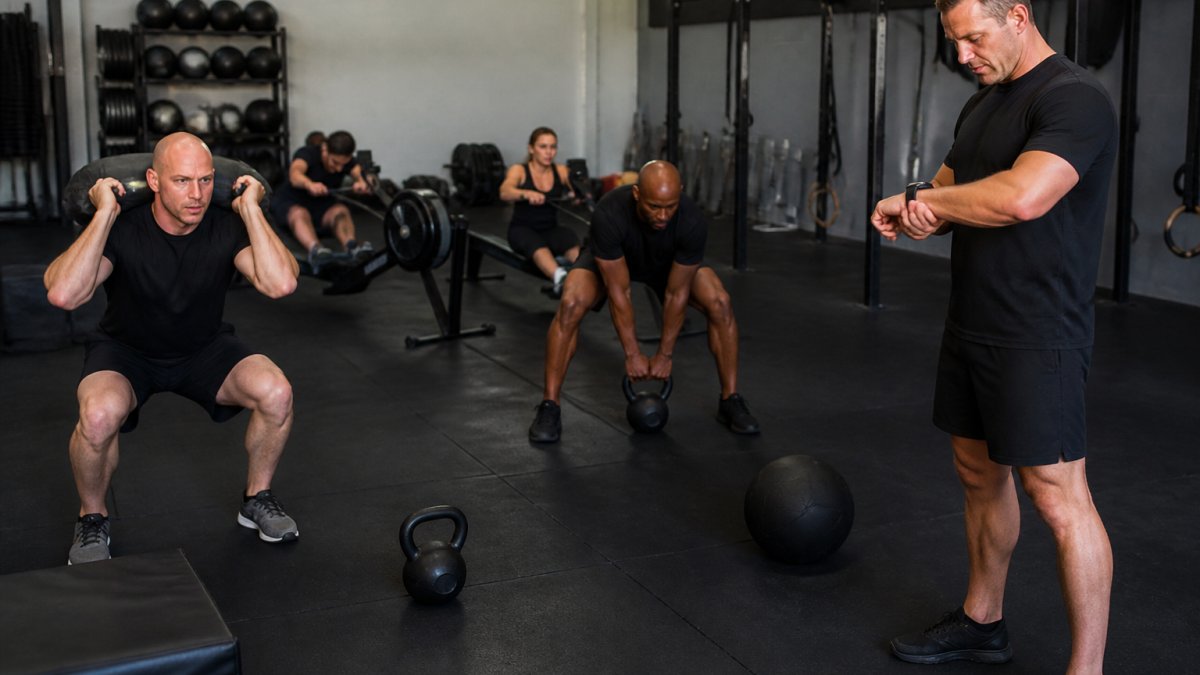
Run it as a circuit, resting 60-90 seconds between rounds:
- Goblet squat: 10 reps
- Push-ups: 15 reps
- Kettlebell swing: 15 reps
Complete 3-4 rounds. Adjust the load so the last two reps feel hard but controlled.
For a deeper look at how strength training supports performance across the lifespan, the American College of Sports Medicine position stands are a solid, evidence-based reference.
Who Benefits Most and Who Should Skip It
Tactical fitness training is not a universal upgrade. It is a tool built for a specific job. Whether it pays off depends on whether your life actually contains that job's demands.
Who Gets the Strongest Return
The clearest returns go to people whose work or goals require physical readiness under load and fatigue:
- Law enforcement officers who face foot pursuits, subject control, and long shifts in kit.
- Active-duty military personnel training for occupational standards and deployment demands.
- Private security and executive protection agents whose job is to move a principal out of a bad situation, not to win a powerlifting meet.
For these groups the training is not a hobby but job insurance. The return shows up as passing fitness tests, staying on the job after an injury that would sideline an untrained peer, and performing when the stakes are real.
Who Should Think Twice
A few groups should pause before spending on a tactical program:
- Complete beginners with no training base. Tactical programming assumes you can already squat, hinge, press, and carry without pain. Build a general base first, it is cheaper and safer.
- Anyone recovering from an injury without medical clearance. A tactical program will not rehab a torn shoulder. Get cleared first.
- People who want a plan with zero time commitment. Tactical fitness demands 4-8 hours a week. If that is not available, the money is wasted.
The Opportunity Cost Nobody Mentions
Every dollar and hour spent on tactical programming is one not spent elsewhere, and that trade-off deserves a straight answer.
- Versus a general gym membership: A $40-a-month gym and a free beginner program can build a solid base. Tactical programming adds value only when your job demands load carriage, work capacity under fatigue, and job-specific testing.
- Versus sport-specific training: If you compete in a sport, train for that sport. Tactical fitness optimizes for operational tasks, not for a sport's energy system or skill demands.
- Versus a self-directed plan: A motivated self-starter with a good template can capture most of the benefit without a coach. Coaching pays off most for people who need correction, structure, or accountability.
Risks and Limitations to Weigh
Tactical training is not risk-free, and honest programs say so.
- Injury risk from too much too soon. The most common failure mode is ramping volume faster than joints and connective tissue can adapt. Progressive overload and planned deloads are not optional.
- Excessive complexity. Some programs stack so many modalities that recovery suffers and progress stalls. Simpler is often better.
- Recovery demands. Tactical training is demanding. If sleep, nutrition, and stress management are not in place, the training becomes another stressor rather than an adaptation signal.
For civilians chasing general health, conventional training plus good habits delivers most of the benefit at lower cost. For people whose job depends on physical readiness, the investment is usually worth it, but only if the program matches your schedule, goals, and recovery.
The Verdict: Is Tactical Fitness Training Worth the Investment?
Is tactical fitness training worth the investment? For most people in demanding roles, yes. The return shows up as better job performance, fewer injuries, and more confidence under pressure.
The catch is fit: a program only pays off if it matches your schedule, goals, and recovery. Our Code Orange pre-workout is made for high-alert sessions, and our Lemon Strike formula uses L-Citrulline, L-Leucine, L-Isoleucine, L-Valine, Taurine, and L-Glutamine to support energy, focus, and recovery.

Start with a plan you can repeat, fuel it well, and give it 8-12 weeks before you judge the return. Ready to train like your job depends on it? Explore the lineup at Executive Protection Fuel and find your fuel.
Frequently Asked Questions
Is tactical fitness training worth the cost?
It depends on your goals and budget. A tactical fitness training program typically costs $100 to $300 per month for coaching, plus equipment and possibly supplements. If your job requires operational readiness, the investment can pay off through better performance, fewer injuries, and improved mission readiness. If you are a civilian with general fitness goals, a conventional strength and conditioning program may be more cost-effective.
How is tactical fitness different from general fitness?
Tactical fitness focuses on job-specific demands like load carriage, rucking, and training under fatigue, while general fitness targets overall health. A tactical fitness workout might include weighted carries, obstacle courses, and work-rest intervals that mimic real-world scenarios. General fitness tends to emphasize aesthetics or basic strength and cardiovascular endurance without the tactical tasks that law enforcement, military, and security professionals face.
Can you train for tactical fitness without joining a paid program?
Yes. You can create your own tactical fitness program using free resources, focusing on progressive overload, periodization, and functional movements. Many people build effective routines with bodyweight exercises, rucking, and interval training. However, a paid program offers structured programming, coaching, and accountability, which can accelerate progress and reduce injury risk. If you are self-motivated and understand program design, a DIY approach can work.
What should a tactical fitness program include?
A solid tactical fitness program should include strength training, cardiovascular endurance work, functional fitness exercises, and recovery strategies. Look for progressive overload, periodization, and training under load or fatigue. It should also address mobility, injury prevention, and stress tolerance. Programs tailored to your specific job demands, such as law enforcement or military, are ideal. Always ensure the program fits your schedule and includes measurable fitness assessments.