
Table of Contents
- What Enhanced Performance in High-Stakes Situations Actually Requires
- Nutrition for Shift Workers: Fueling Long Hours Without the Crash
- Stress Management Techniques for First Responders Under Pressure
- Sleep and Recovery for High-Stress Jobs: The Foundation Nobody Skips
- Pre-Workout Supplements for Tactical Athletes: What to Look For
- Measuring Performance and Wellness Together
- Preventing Burnout and Cumulative Stress Over a Career
- Frequently Asked Questions
Last Updated: October 5, 2026
What Enhanced Performance in High-Stakes Situations Actually Requires
High-stakes performance for health and wellness is the deliberate practice of sustaining physical readiness, mental clarity, and emotional regulation when the cost of failure is high.
At Executive Protection Fuel, we talk to law enforcement officers, active-duty military personnel, and executive protection agents every week.
Below, we break down what that system looks like in practice, from shift nutrition to stress protocols to the metrics that tell you whether the whole thing is working.
The Four Pillars of Sustained Readiness
We group high-stakes performance into four pillars: fuel, sleep, stress regulation, and measurement. Neglect any one and the other three degrade. A well-fed officer running on five hours of sleep will still make poor decisions in a volatile situation.
The CDC guidance on shift work and sleep is blunt about this: irregular schedules disrupt circadian rhythm, and the effects compound over time. The pillars are not independent. They are load-bearing walls.
Nutrition for Shift Workers: Fueling Long Hours Without the Crash
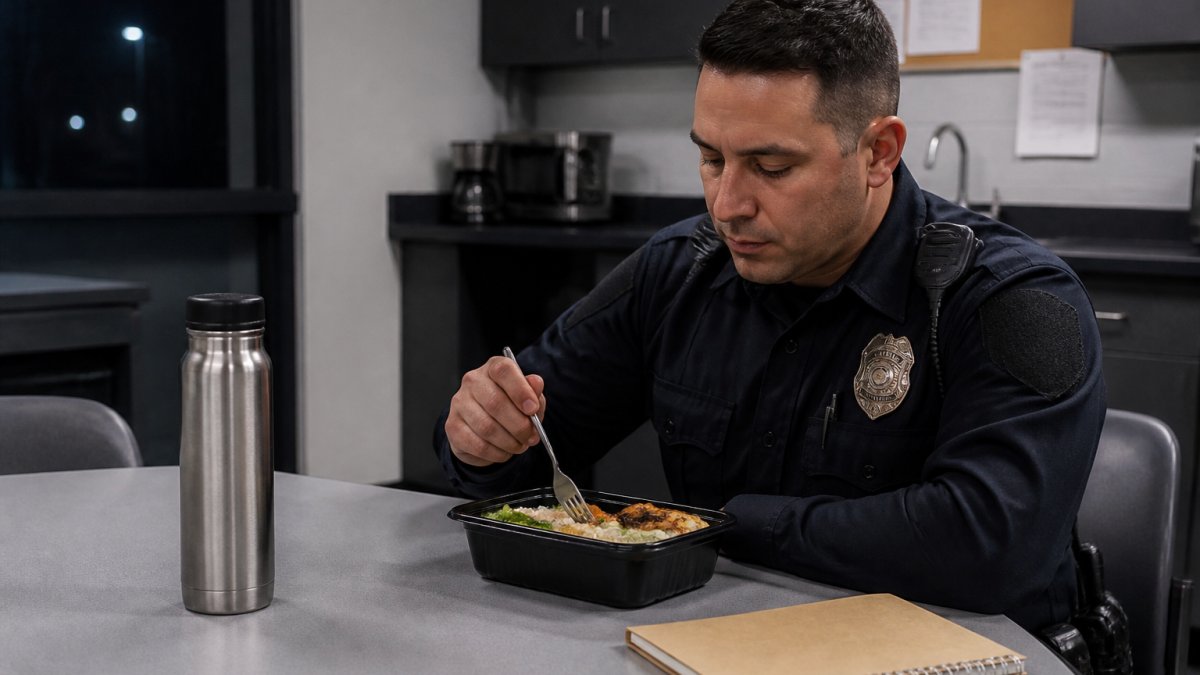
Nutrition for shift workers is the practice of timing meals and macronutrients around an irregular schedule so energy stays level instead of spiking and collapsing. The goal is not perfection.
What to Eat Before a Demanding Shift
A common approach is a meal built around protein, complex carbohydrates, and moderate fat two to three hours before your shift. Think eggs and oats, or chicken with rice and vegetables.
What most guides miss is hydration. Many officers and agents run mildly dehydrated for entire shifts because they limit fluids to avoid bathroom breaks during details. That trade-off costs focus.
Stress Management Techniques for First Responders Under Pressure
Stress management techniques for first responders are the specific, repeatable methods used to bring heart rate and breathing back under control during and after acute pressure. These are not relaxation hobbies. They are tools you deploy in the moment.
Box Breathing and Tactical Pause Protocols
Box breathing is a controlled breathing pattern: inhale for a count of four, hold for four, exhale for four, hold for four. Repeat.
A tactical pause is the deliberate two-to-five second break before acting, used to confirm the situation matches your read of it.
The National Institute of Mental Health resources on stress notes that chronic, unmanaged stress raises the risk of both physical and mental health problems, which is why these protocols matter beyond a single shift.
Sleep and Recovery for High-Stress Jobs: The Foundation Nobody Skips
Sleep and recovery for high-stress jobs is the non-negotiable base layer. Every other pillar depends on it. You cannot fuel, breathe, or train your way out of chronic sleep debt.
The mechanism is worth understanding because it explains why willpower fails. Sleep pressure builds through the day as adenosine accumulates in the brain, and it clears during sleep. When you cut sleep short, adenosine stays elevated, which is why you feel foggy even after caffeine.
Role-Specific Recovery Levers
The right recovery protocol depends on the schedule you actually work, not a generic checklist.
- Rotating shift workers (12-hour nights, swing shifts): Anchor sleep is the priority. Protect one consistent 4-to-6 hour block that stays the same regardless of shift, then nap around it. This gives your circadian system a fixed reference point when everything else moves.
- On-call and standby roles (executive protection, emergency medicine): The threat is fragmented sleep, not short sleep. A 20-to-30 minute nap before a known high-demand window restores alertness without grogginess, because it stays out of deep sleep. Keep the nap short and set an alarm.
- Leaders and decision-makers on irregular travel: Light exposure is the lever. Get bright light in the first hour after waking in the new time zone and dim light in the two hours before target bedtime. This shifts the internal clock faster than willpower alone.
The Recovery Stack Beyond Sleep
Sleep is the foundation, but recovery is a stack. Three additions matter for people in sustained high-stakes roles:
- Strategic napping. A 20-minute nap improves alertness and reaction time without the inertia of a 60-minute nap. For night-shift workers, a nap before the shift is often more useful than one during it.
- Active recovery days. A full rest day is not always the answer. Low-intensity movement, walking, mobility work, easy cycling, can clear residual fatigue better than complete inactivity for people who are physically active on the job.
- Deload weeks. Every four to six weeks, cut training volume by roughly a third. Cumulative fatigue from work plus training compounds, and a planned deload prevents the unplanned crash.
Caffeine Timing, Done Properly
Caffeine has a role, but timing matters. Caffeine has a half-life of roughly five to six hours in most adults, meaning half of what you drink is still circulating five to six hours later. A cup at the start of a night shift is sensible. A cup four hours before you plan to sleep is self-sabotage. A common pattern that works: caffeine early in the shift, none in the final third, and a hard cutoff six hours before the target sleep window.
Pre-Workout Supplements for Tactical Athletes: What to Look For
Pre-workout supplements for tactical athletes are formulas designed to support energy, focus, and endurance for people who train around demanding schedules. The category is crowded and unevenly regulated, so the label matters more than the marketing.
Third-Party Testing and Drug Screening Concerns
For anyone subject to drug screening, third-party testing is not optional. Look for products that state they are lab tested and list their ingredients transparently. A proprietary blend that hides doses behind a single "blend" number gives you no way to assess what you are taking.
Our own formulas, like EXECUTIVE PROTECTION FUEL - CODE ORANGE - PRE-WORKOUT, are built for people who train around long shifts, with a focus on energy support, focus, and endurance. Our LEMON STRIKE ENERGY PRE-WORKOUT is an amino-acid-based formula featuring L-Citrulline, L-Leucine, L-Isoleucine, L-Valine, Taurine, L-Glutamine, Niacin, and Vitamin B6, and it is lab tested.
EXECUTIVE PROTECTION FUEL - CODE ORANGE - PRE-WORKOUT →


| What to Check | Why It Matters | Red Flag |
|---|---|---|
| Third-party lab testing | Verifies label accuracy | No testing claim at all |
| Full ingredient disclosure | Lets you assess each dose | Proprietary blend hiding amounts |
| Stimulant content | Affects jitter and heart rate | Undisclosed stimulant sources |
| Serving size clarity | Prevents accidental overuse | Vague "scoop" guidance |
Measuring Performance and Wellness Together
Measuring performance and wellness together means tracking both output and the inputs that sustain it, rather than judging yourself on results alone. A fast run time means little if you are sleeping four hours and running on caffeine.
Most guides stop at "track your sleep and mood." That is not measurement, that is journaling. Real measurement pairs an objective output with an objective input and a subjective read, then watches the relationship over time.
The Three-Layer Tracking Model
A practical system has three layers, each cheap to collect:
Layer 1, Objective inputs (daily, 30 seconds):
- Sleep duration and sleep window consistency (when you went to bed and woke, not just hours)
- Training load (session type and rough intensity, 1-5 scale)
- Fluid and meal timing relative to shift start
Layer 2, Objective outputs (per shift or per session):
- Decision quality: any near-miss, hesitation, or reversal you can recall
- Reaction or response time on a known task (range drill, simulation, timed scenario)
- Task completion without rework
Layer 3, Subjective read (daily, 10 seconds):
- Energy 1-10
- Mood 1-10
- Perceived stress 1-10
Three numbers, once a day. That is the whole system. The value is not in any single day, it is in the pattern across two to four weeks.
How to Read the Pattern
The point of tracking is to catch degradation before it becomes a bad month. A few decision rules most practitioners find useful:
- Two consecutive weeks of declining sleep window consistency → treat as a yellow flag and pull back training load before performance drops.
- Subjective energy trending down while objective output holds → you are compensating with effort. This is the classic pre-burnout pattern and the time to use a deload week.
- Objective output dropping while inputs look fine → check the inputs you are not tracking: hydration, nutrition timing, and cumulative stress from outside work.
A Simple Weekly Review
Once a week, spend ten minutes on four questions:
- Did my sleep window stay within a one-hour band most nights?
- Did I hit my planned training sessions, or did I skip them for work?
- Were there any decisions I would make differently with more sleep or better fuel?
- What is one input I can tighten next week?
Patterns emerge fast. When sleep drops for two weeks, performance follows. Catching that early is how you prevent a bad month.
What Not to Measure
Avoid tracking everything. Wearables generate dozens of metrics, and most of them are noise for this purpose. Heart-rate variability, readiness scores, and recovery percentages can be useful, but they are only meaningful against your own baseline, and they are easily over-interpreted. Pick two or three inputs, two outputs, and three subjective scores. Add complexity only when the simple version stops giving you signal.
Preventing Burnout and Cumulative Stress Over a Career
Preventing burnout and cumulative stress over a career is a long-game discipline. Acute stress is survivable. It is the slow accumulation, shift after shift, year after year, that ends careers early.
The protective habits are unglamorous: real days off, honest self-assessment, and using the resources available to you. The Substance Abuse and Mental Health Services Administration operates a free, confidential helpline for people in high-stress professions who need support.
Frequently Asked Questions
How can nutrition support performance during high-stress work?
Nutrition directly affects focus, energy stability, and decision-making under pressure. For shift workers, eating balanced meals with protein, complex carbohydrates, and healthy fats every 3-4 hours helps maintain steady blood sugar and avoid the crash that follows high-sugar snacks. Staying hydrated and limiting caffeine after the midpoint of a shift also protects sleep quality. These habits support enhanced performance in high-stakes situations without relying on stimulants that wear off mid-shift.
What should you eat before a demanding shift or high-stakes task?
A meal with slow-digesting carbohydrates, lean protein, and moderate fat about 2-3 hours before a demanding shift gives sustained energy. Examples include oatmeal with whey protein and almond butter, or grilled chicken with brown rice and vegetables. Avoid heavy fried foods and large sugar loads, which cause energy spikes followed by sharp drops. If you train before your shift, a pre-workout supplement for tactical athletes taken 20-30 minutes prior can support focus and endurance.
How can you stay focused when working under pressure?
Structured breathing protocols like box breathing (inhale 4 seconds, hold 4, exhale 4, hold 4) calm the nervous system and sharpen attention during high-pressure environments. Brief tactical pauses between tasks, proper hydration, and protein-rich snacks also help. Research on stress management techniques for first responders shows that short, repeatable routines practiced during training carry over into real incidents, reducing reaction time and improving decision-making when stakes are highest.
What wellness habits help prevent burnout in high-stress professions?
Preventing burnout requires protecting sleep, scheduling recovery days, and building social support. Aim for 7-9 hours of sleep per 24-hour period, even if split across shifts. Use a wind-down routine before sleep and keep the room cool and dark. Regular exercise, even 20 minutes daily, reduces cumulative stress. Peer check-ins and professional mental health support also matter. These proactive strategies build the resilience needed for sustained high-stakes performance over a full career.
How much sleep do people in demanding jobs need for recovery?
Most adults need 7-9 hours of sleep per 24 hours for full recovery. People in high-stress jobs often accumulate sleep debt from rotating shifts and overtime. Split sleep (for example, a 5-hour core block plus a 2-3 hour nap) can partially offset this, but consistency matters more than total hours alone. Prioritize sleep and recovery for high-stress jobs by keeping a fixed sleep window when possible and avoiding caffeine within 6 hours of bedtime.
Are pre-workout supplements appropriate before a high-pressure shift?
Pre-workout supplements for tactical athletes can support energy, focus, and endurance before training or a demanding shift, but only if the formula matches the demands. Look for third-party tested products with transparent labels, moderate caffeine, and ingredients like L-citrulline and B-vitamins. Avoid formulas with proprietary blends or unlisted stimulants. If you are sensitive to jitteriness, start with half a scoop and assess your response during a low-stakes training session before relying on it operationally.
The challenge is not knowing what to do. It is doing it consistently when the schedule fights you every week. Executive Protection Fuel builds pre-workout formulas for exactly that reality: veteran-owned, lab tested, and designed for energy, focus, and endurance around demanding shifts. Explore our Code Orange and Lemon Strike formulas and build a system that holds up over a career.